
What To Do with a Suborbital Spaceplane?
Updated: Jun 19
Thought Piece
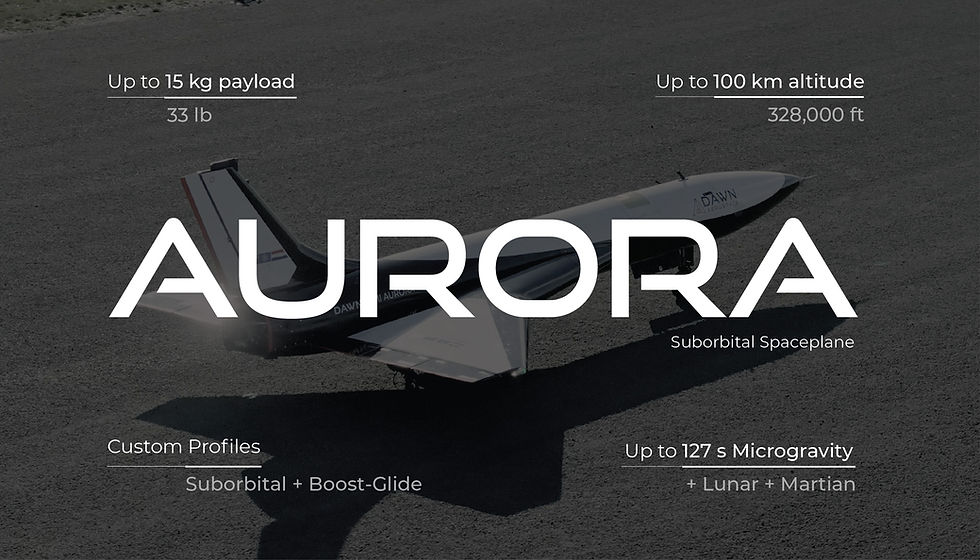
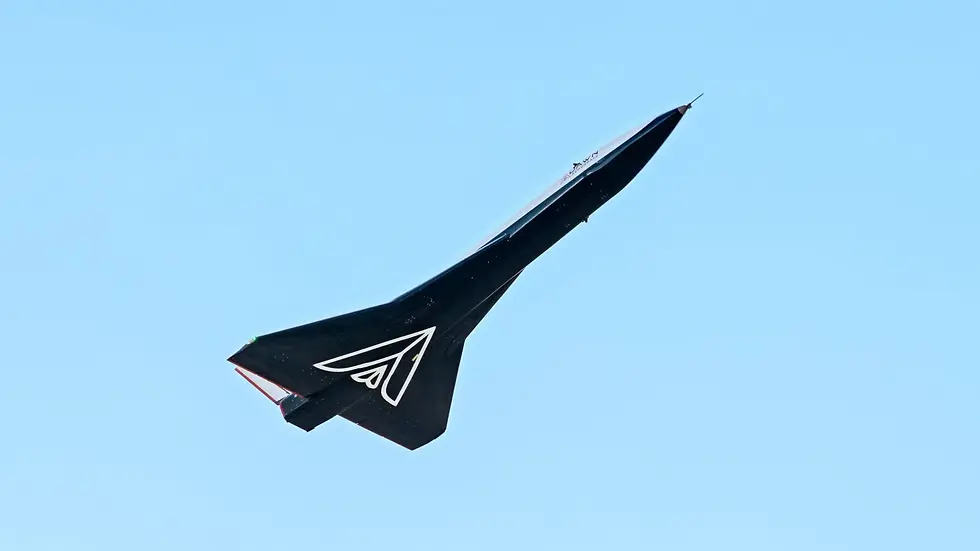
Historically, when people hear the word "spaceplane," they picture the Space Shuttle, which was, functionally, not much more than a very large rocket that just happened to have wings. Dawn Aerospace's Aurora sits at the opposite end of that spectrum: an aircraft equipped with a rocket engine, allowing it to fly beyond the atmosphere.
Designed to operate seamlessly within existing aviation infrastructure, Aurora is built to carry a 15 kg (33 lb) payload to a 100 km (328,000 ft) altitude at speeds of Mach 3.7 before returning to a standard runway. Crucially, the vehicle is designed for a four-hour turnaround time. Because, as it turns out, aircraft and rockets alike are considerably more useful in the air than they are sitting on the ground.
We aren't just drawing this on whiteboards. With 64 flights completed, Aurora is currently expanding its flight envelope, conducting operations at supersonic speeds and altitudes above 24 km (82,000 ft).
The traditional aerospace business model often involves spending a vast amount of money and hoping your single-use vehicle performs flawlessly on the first try. Aurora’s architecture, which combines a small physical footprint with rapid reusability, replaces that high-stakes gamble with something largely novel to the space industry: iterative development.
Turning a monumental launch event into routine aviation operations opens up some interesting applications.
Microgravity Pharmaceutical Research
One of the most promising use cases of microgravity isn't cosmic exploration. It's medicine.
Understanding the precise atomic structure of proteins is a foundation of modern drug development. On Earth, gravity creates convection currents that disrupt protein crystal formation. In microgravity, they grow with highly ordered structures. Merck demonstrated the value of this in 2017 when they crystallized their cancer drug Keytruda in orbit, allowing it to be administered via a quick injection rather than a lengthy IV drip.
Researchers led by Sarah Kessans at the University of Canterbury have built a compact, automated laboratory to advance this research. They are preparing to test elements of this lab aboard Aurora to make access to microgravity less of a logistical hurdle and more of a routine service.
Space is exciting. Better cancer treatments are exciting too.
Test Space Hardware Before It Goes to Space
Space is an unforgiving place to discover a design flaw. Traditionally, engineers spend years building a payload only to launch it once, and if a minor component fails, they might not get another try until the next funding cycle.
Aurora allows engineers to test sensors, communications systems, and software in realistic flight conditions—between commercial aviation altitudes and orbit—before committing them to a multi-million-dollar and long-lead-time orbital launch.
Researchers from Arizona State University are already utilizing this, having flown imaging payloads aboard Aurora to gather flight data. The goal isn't just to fly hardware; it's to find out what breaks before it's in orbit, and to be able to tweak performance between successive flights.
Radar Tracking and Threat Simulation
Defense systems need to track fast-moving objects such as cruise missiles and hypersonic vehicles. To test these ground-based radar networks, you generally need a realistic, fast-moving target. Instead of firing a real weapon, with all the cost and danger associated with real-world scenarios, Aurora offers a recoverable alternative.
By adjusting its radar cross-section (RCS), the vehicle can masquerade as various customized threats. This capability recently transitioned from theory to reality during the DARTE campaign. Aurora flew fast, the Royal New Zealand Navy tracked it with its defensive sensing networks, and everyone got to keep their hardware at the end of the day. What's more, we flew another sortie the following day.
Accelerating the Speed of Science
In highly technical fields such as high-speed aerodynamics, materials science, semiconductor manufacturing, defense wargaming, or anything in between, progress requires real-world experimentation in relevant environments. The more real, and the more frequently you can run a test, an experiment, or training, the better.
Historically, high-performance flight testing has been constrained by the sheer cost of losing the test vehicle, which, with expendable systems, happens whether the test is a success or not. The fear of failure only strengthens that chokehold. For example, if you launch a microgravity experiment on an expendable rocket, it is a one-way, high-stakes flight. If a loose wire or minor software glitch bricks your system three seconds after deployment, that's it. Years of budget, engineering momentum, and critical data are instantly reduced to debris at the bottom of the ocean.
Because you cannot afford to fail, innovation is naturally slowed by caution. Also known as paralysis by analysis.
The ultimate superpower of a rapidly reusable spaceplane is that you can fly, fail, fix and fly again, within hours.
And you can do so without risking the project, or your career. This is the critical unlock to accelerate the speed of science.
In real terms, that means you can bolt an experimental thermal protection system or a new defense sensor onto the vehicle, fly it at Mach 3+, discover an anomaly, land, fix it on the workbench in the hangar, and fly it again tomorrow. This operational tempo also extends perfectly to defense readiness—allowing troops to train iteratively against realistic threats. You don't just reduce the cost of access; you fundamentally change the velocity at which you can make mistakes, learn from them, and try again.
Dense Test Data Matrix
Test outcomes in highly technical fields are also usually dependent on multiple test parameters. Temperatures, pressures, gravity magnitude and vectors, chemical makeup, and exposure times, etc. And when scientists are not sure what is going on, they usually blame the phase of the moon.
When there are multiple, potentially non-linear parameters, we can encounter scenarios where we really need hundreds, if not thousands, of tests to fully explore the test sample space. With a single flight test and years between tests, scientists have not had that luxury, and science suffers.
Aurora changes that paradigm. We are baselining operational rates of 100 flights per annum per vehicle. As we build out the fleet, we will have capacity for thousands of flights per annum. This will allow for dense data matrices to be gathered, enabling a real understanding of uncommonly observed phenomena in microgravity and high-speed flight. Our guess is that this also leads to a reduction in the moon being blamed for the unknown.
Aurora: Bringing Space and High-Speed Flight to Where It’s Needed
A key unlock mostly overlooked in the space industry is not the “what can you do?”, but “where can I do it?” These are often coupled questions, and many applications only make sense in some areas, or benefit massively from being close to a hub where that industry is located. Once again, the mentality of 'an aircraft with the performance of a rocket' brings massive operational efficiency and flexibility to bring capability to where it’s actually useful.
Access to space and high-speed flight has traditionally required massive infrastructure, bespoke launch pads, and a small army of personnel. Aurora operates as an uncrewed system with a ground crew of just six people.
The vehicle itself is operable from almost any 1,000 m (3,300 ft) runway. It may not be something you want to fly out of a busy airport like LAX or Heathrow, but there are literally thousands of runways worldwide with appropriate ground infrastructure and relatively few users. This is a massively underutilized infrastructure network that Aurora can use to go where it is needed.
Final Thoughts
We think it’s fair to say Aurora will be the first vehicle with "space" performance, yet with an aircraft-style business model built around rapid reuse. The above is our best guess at what we think our spaceplane will be used for, based on conversations we have had with users over the last few years, as well as the payloads and missions we have already flown.
But we also recognize that, like the internet in the 1990s, the most interesting applications may not have even been thought of yet. That’s what makes us really excited and is ultimately the point of making space truly scalable and sustainable.
So, what do you want to use a suborbital spaceplane for?

For mission profiles, vehicle specifications, and flight data, visit dawnaerospace.com/spaceplane

Comments