
The Loop Network and Seeding the Market for In-Orbit Refueling

Author: Stefan Powell, CEO
Industry has been talking about in-orbit refueling as a major unlock for over a decade. It makes intuitive sense: High-value satellites are frequently retired, not because components fail, but because they run out of propellant. These $5-200m assets could have their lives doubled with only a few million dollars of fuel
For national security satellites, it’s not just an economic problem, but a vulnerability. Propellant is a strategic and life-limiting resource their adversaries are actively trying to degrade. They force maneuvers to deplete their precious propellant early. Space Forces around the world are racing to build “bodyguard” satellites to fend off these adversaries.
Despite the obvious economic benefits of refueling and strategic vulnerabilities of the status quo, the industry has largely failed to move refueling beyond concept studies, bespoke demonstration missions, and hyped-up press releases. However, there are signs this is changing. Defense agencies, are finally moving from having refeuling as a loose strategic priority and "on the roadmap", to writing refueling into their requirements and budgets. It seems the industry is in fact desperate for a real path forward, even if that path is not yet clear.
While the technical challenges of docking and propellant transfer are hard, they are solvable. The physics isn't stopping us; the market architecture is.
From our observation, the industry is currently paralyzed by three compounding chasms:
Chasm 1: The Technology Chicken-and-Egg Problem
A refueling network is only viable if spacecraft are designed to interface with it. Yet, satellite operators have zero immediate commercial incentive to pay for, integrate, and carry refueling hardware if there is no servicing vehicle in orbit to actually use it.
Conversely, companies building those servicing vehicles face a non-existent market because no satellites are flying with compatible interfaces. The space industry is littered with PowerPoint depots and companies raising capital to build gas stations for a fleet of disposable cars with no gas caps.
Chasm 2: The Time Lag
Even if we could wave a wand today and have every new satellite launched include a standardized refueling port, we would immediately hit the second chasm: time. Satellites launch with full tanks. Depending on the mission, it takes five to ten years before those spacecraft deplete their propellant reserves and actually need to purchase fuel.
This creates a large commercial gap which is hard to resolve with contracts. Satellite operators are unlikely to sign a long-term refueling agreement for a service that does not yet exist, offered by a venture-backed startup which may not survive the next funding cycle.
The only real precedent we have for a similar service illustrates the problem perfectly. When Intelsat signed a life-extension contract for Northrop Grumman's Mission Extension Vehicle (MEV), they reportedly paid $13 million a year for surrogate station keeping. But developing and launching that bespoke servicing vehicle cost hundreds of millions of dollars. It proved that a legacy aerospace prime with a massive balance sheet can absorb massive upfront CapEx to bridge the trust gap, but as a scalable commercial model, it is deeply unprofitable.
Satellite operators are unlikely to take that same leap of faith with a startup. On the flip side, it is virtually impossible to sustain a venture-backed business model while waiting half a decade for your first customer to run out of gas.
Chasm 3: The Mission Design Paradigm Shift
The third chasm is perhaps the deepest. Refueling breaks the tyranny of the Tsiolkovsky rocket equation and shifts propellant from a hard mission constraint that must be decided on years in advance, into an operational expense (OpEx) that can be taken on during the mission.
But taking full advantage of this requires a massive shift in operational strategy. Redesigning missions to utilize refueling to its maximum capability will require years of new analysis, design, manufacturing, and launch before the first drop of propellant is ever transferred.
The upside, however, is massive. When satellites are designed to be refueled frequently, entirely new capabilities open up: responsive high-delta-V maneuvers, dynamic space operations, sustained VLEO orbits, and logistics out to the Moon all become dramatically more viable. We will cross this chasm too. It will just take time. The earlier a satellite operator can lean into this massive upside, the better!
The Commercial Bridge
The "build it and they will come" approach to orbital refueling is a very challenging economic proposition. Investors or governments are unlikely to fund hundreds of millions of dollars for servicing vehicles to loiter in orbit for years while satellite manufacturers re-establish whole constellations. And even if we could convince them to take such a leap of faith, I wouldn’t want to. There is a better way.
We can approach the problem from the bottom up. We can make the inclusion of a refueling port a highly practical, low-risk decision today to seed the market with real customers, long before the service exists. Here is how:
At Dawn Aerospace, we have a superpower: we are a manufacturing company already delivering hardware at scale. In the last 12 months alone, we delivered 50 nitrous bipropellant systems to customers worldwide. We have 5 years of flight heritage and now 40+ systems on orbit.
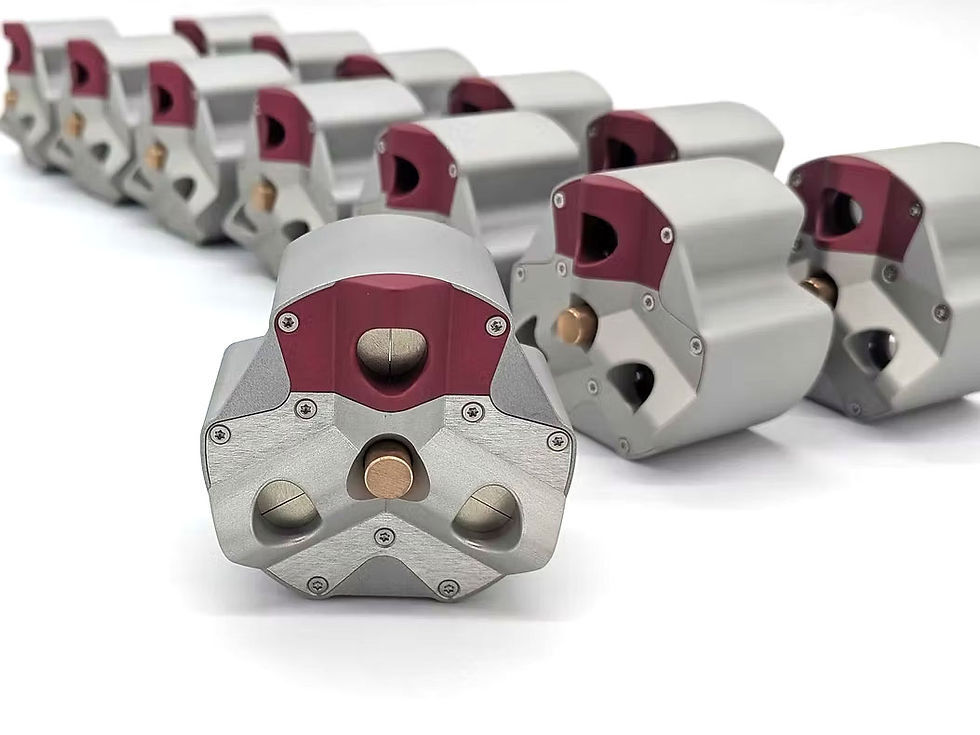
Every propulsion system requires a propellant loading interface for ground integration. Our SatDrive systems already include this. Rather than treating that interface strictly as a ground-only utility, we redesigned it to support both terrestrial fueling and future in-orbit servicing.
The result is the Docking and Fluid Transfer (DFT) port. It replaces the conventional fill-and-drain valve with a passive docking interface, adding only 600 grams of mass and requiring minimal integration changes. We have made the DFT port a standard feature, not an optional upgrade, on our SatDrive systems above 10 kNs of capacity.
This decision completely flips the economic calculus. Operators no longer need to make a speculative investment. Because our systems use storable, self-pressurizing liquefied gases, the mechanics of transfer are vastly simplified.
This also helps bridge the mission design chasm. By standardizing the DFT port today and presenting a clear, funded path to a service, we give operators the tangible proof they need to start reimagining their architectures now.
If even half of the systems we deliver starting today were refuelable, we would have 100+ compatible satellites on orbit within five years—potentially billions of dollars of hardware on orbit that can majorly extend their missions and begin to treat fuel as OpEx, not a finite resource.
That is the goal.


Progress: Seeding the Market and Building the Loop Network
For the last few years, we have been quietly chipping away at this vision. We are now well beyond theory and hypotheticals, and are starting to see tangible adoption.
The Royal Netherlands Air Force's PAMI-1 mission will incorporate the DFT port, marking the first sovereign Dutch satellite capable of refueling.
We are working with CNES, Exotrail, and Infinite Orbits on next-generation architectures using DFT and refueling.
Two other companies are under contract for DFT-equipped systems, the first of which is expected to launch later this year.
But seeding the market is only half the equation. We are also building the service, which is now a fully funded program.
The Loop on-orbit refueling network consists of two vehicles: the Space Utility Vehicle (SUV) and the Orbital Propellant Depot (OPD). The SUV is a highly capable, reusable spacecraft designed to navigate, dock, and deliver propellant—along with other in-orbit services. The OPDs, by contrast, are entirely expendable. They are just a little bit more than "dumb tanks" that can be launched to strategic orbits. In future, we envision they will be launched opportunistically on spare launch capacity. After all, rockets often fly half empty.
SUV and OPD mini are in active development. We intend to launch them both in 2028 to demonstrate docking and propellant transfer. Our existing propulsion business allows us to fund this development and raise capital with drastically lower risk. By 2029, we intend to offer commercial refueling to a fleet of satellites that are already there, ready, and waiting.

The Path Ahead
If we want sustainable, scalable space transportation, we have to stop treating satellites as isolated, disposable machines. Infrastructure isn't built by magic; it’s built by making smart, pragmatic hardware choices today.
We believe the path presented here is one that doesn’t require miracles or existential leaps of faith from our customers or government. It’s now largely within our control to make it happen. That doesn’t mean it’s easy, but we have a very decent shot at unlocking a revolution, and very little downside to trying.
We feel incredibly privileged to be in a position to turn this vision into a reality. We are laser-focused on the execution: continuing to scale our propulsion system production, delivering as many of those systems with DFT ports as possible, and preparing for our 2028 on-orbit refueling demo between SUV and an OPD mini.
If we can do that, I think it's fair to say the transition to a refuelable orbital economy is finally underway.
FOLLOW US
@dawnaerospace


Comments