
15 Flights At The Dawn of the Aurora Spaceplane Era
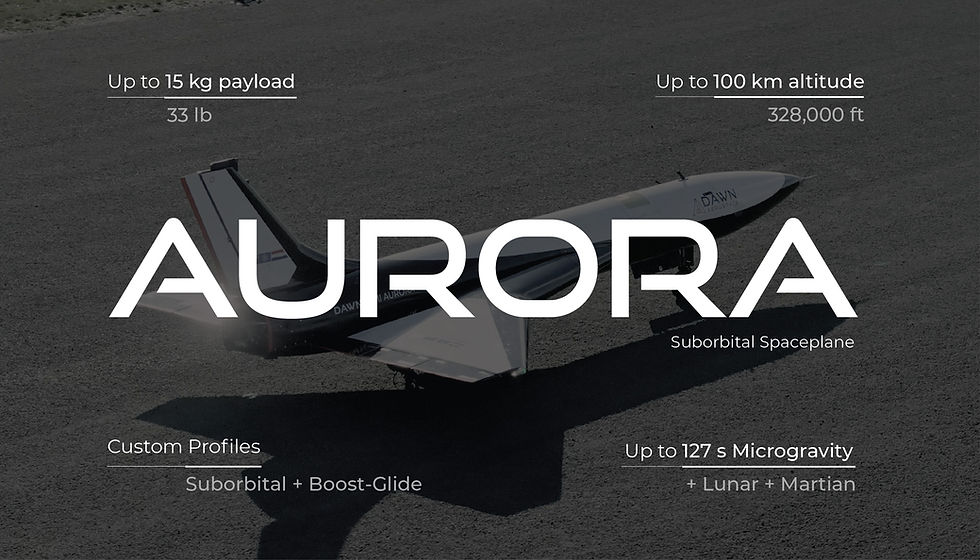
After 47 flights on jet power, Aurora has evolved to a rocket-powered and world-record-setting suborbital spaceplane. Flight 48 to Flight 62 showcase these 15 test flights conducted between 2023 and 2025 demonstrating rapid testing and relentless innovation.
Flight testing is rarely a smooth process, and we had our own fair share of anomalies. From radio glitches to unexpectedly high winds, we saw many real-world effects that pushed our hardware and team to their limits. But this is where a rapidly reusable platform shines. In every case, we could simply land, address the issues, and in most cases, be flying again within hours, not weeks or months. These moments didn't just test our hardware; they proved the robustness of our systems and the expertise of our flight crew.
Some highlights from the flight log and a few "firsts" for our team and the industry:
The Power Shift: On the 29th of March 2023, we transitioned from jet engines to our first rocket-powered flights. This was the debut of our in-house-developed bi-propellant rocket engine in flight after the airframe and avionics were proven on prior flights, with three flights completed in three days.
Rapid Reusability: On the 4th of October 2024, we successfully proved our “turnaround” capability by flying two rocket-powered missions in a single day, in fact, within six hours of one another.
Supersonic History: Aurora flew supersonic on the 12th of November 2024, and did so in an 85-degree climb, also breaking a world ‘time to climb’ record from ground to 20 km altitude, with a time of 118 s.
Commercial Validation: In June/July, we flew four missions for US customers and universities, including our “Pathfinder” campaign. These customers could test their latest and greatest avionics, cameras, and prototype new capabilities, such as a space domain awareness service using the Aurora platform.
Launch site agnostic: These flights were conducted from two locations, Tāwhaki National Aerospace Centre and Glentanner Aerodrome.
The next, and much higher performance iteration of Aurora, is now in production. It is set to be the first vehicle to fly to above 100 km altitude – space – multiple times per day. This will herald in a new era of rapidly reusable sub-orbital launch, and is a massive step towards our mission of scalable and sustainable space transportation.
Watch the full flight compilation below and join the journey:
About Dawn Aerospace
Dawn Aerospace is a space transportation company developing the fastest and highest-flying aircraft ever to take off from a runway, alongside refuellable satellite propulsion.
Their spaceplane, Aurora — now available for missions and purchase — combines the extreme performance of rocket propulsion with the reusability of conventional airplanes to enable high-frequency, low-cost access to suborbital space. Dawn’s propulsion systems are already operating on 42 satellites, and the next step is LOOP — an on-orbit refuelling network, revolutionising sustainability and scalability of in-space mobility.
Founded in 2017, Dawn Aerospace has over 130 staff across offices in the Netherlands, France, New Zealand, and the United States.
FOLLOW US
@dawnaerospace


Comments