
Dawn, Com&Sens and ESA partner on smart composite overwrapped pressure vessels for space.
Delft, Netherlands
Dawn Aerospace continues to expand its satellite propulsion system offering by partnering with Com&Sens to work on smart composite overwrapped pressure vessels (COPVs) with a development contract from ESA’s ARTES Core Competitiveness programme.
The goal of the project is to develop lightweight and smart composite overwrapped pressure vessels for Dawn’s nitrous-based propulsion technology, using innovative embedded sensors. These tanks will be capable of supporting large satellite systems and GEO missions.
“COPVs are the logical next step in expanding our product offering. They are essential for larger satellites doing the most challenging, high-performance missions. Using smart technology during the development allows us to bring a better product to market, faster. We are excited to be able to offer non-toxic nitrous-based propulsion type to a market segment who have never had many options beyond hydrazine,”Dawn CEO, Stefan Powell said.
Propellants are traditionally stored in metal tanks in orbit, but size is constrained due to the weight of metals such as Inconel and titanium. COPVs offer a lightweight structure with high tensile strength and durability, making them ideal for withstanding the harsh conditions of space, including extreme temperatures and radiation.
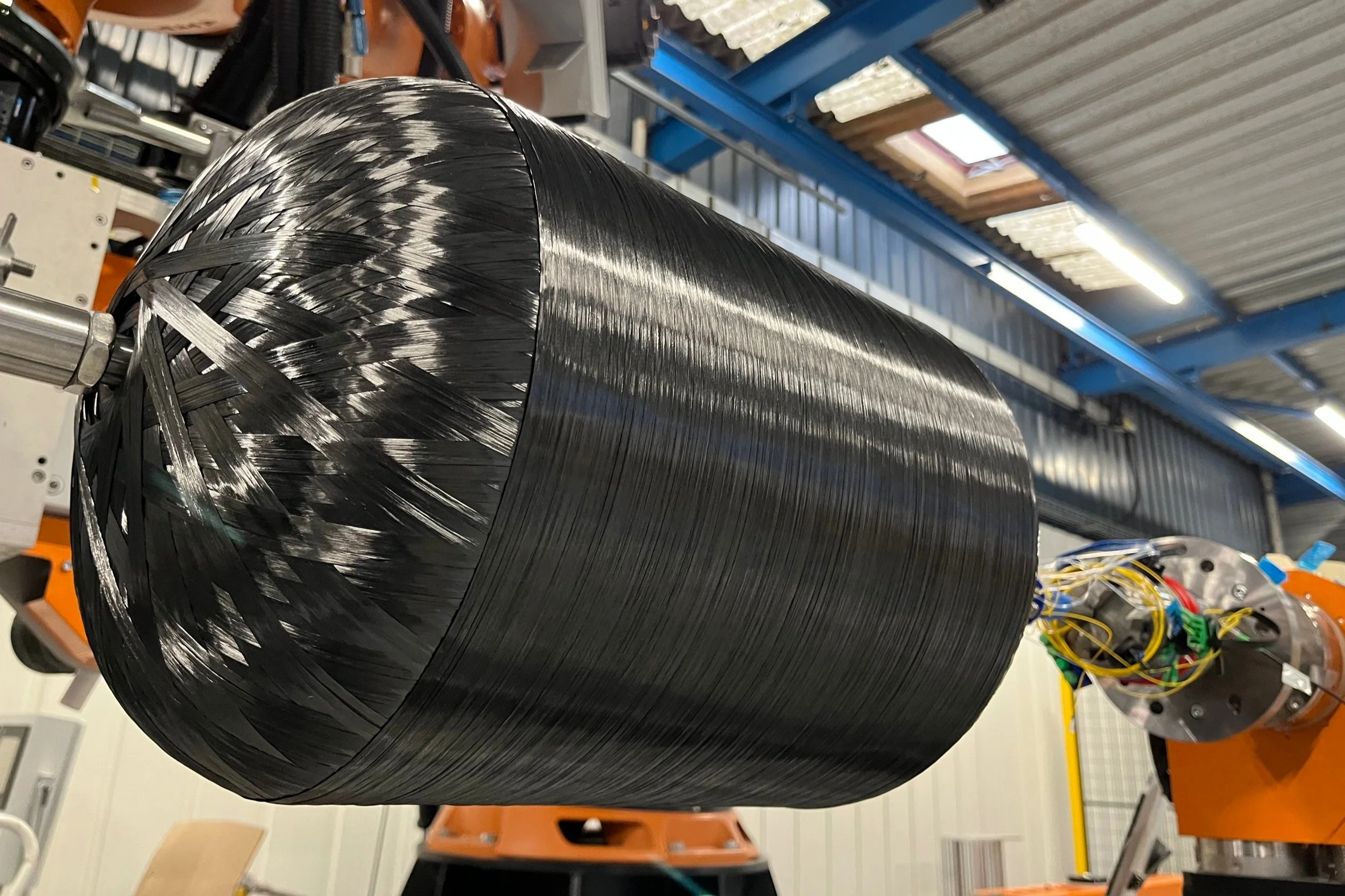
Dawn is designing and manufacturing 30L tanks with an aluminium alloy liner, which are then overwrapped in carbon fibre and epoxy, in precise patterns, using a filament winding machine. Com&Sens is developing solutions for semi-automated sensor embedding during the COPV winding process and is digitizing the production & testing parameters using embedded strain & temperature FBG optical fiber sensors.
Using smart sensors in the process accelerates development and gives much deeper insight into the laminate "status", hence quality, of the vessel during testing and production. Novel ways to embed heaters into the tank liner or overwrap to control pressure in the tanks are also being explored.
Update as of 28/11/2025 at the conclusion of the project:
Key Achievements
1. Technology Advancement and Smart Features
Increased COPV Technology Readiness Level (TRL) from 2/3 to 7.
Successfully manufactured and tested six full-scale COPVs incorporating multiple Smart Features.
The integrated fiber optic sensors allow for real-time strain and temperature monitoring. This allows for detailed tracking of the complete MAIT process including winding, pressure testing, and vibration testing.
Heater integration concept for improved thermal control of self-pressurizing propellants.
2. Building block approach to development
Starting from a lower risk, less optimal, liner material, a transition was made to aluminum, reducing weight and manufacturing lead time.
Small scale ring coupon testing using a test approach to best reflect the unique stress state of pressure vessels gave important insight to drive the design.
3. Design and Manufacturing
Brought both the filament winding process and the finite element analysis processes within Dawn. This allowed for rapid optimization and ultimate control over all phases of the design and composite manufacturing.
Validated spin forming of the selected alloys for liner production.
4. Testing Campaign
Completed many hydraulic, thermal, mechanical, system, and life cycle tests across multiple vessels.
Demonstrated sensor capability to monitor structural health during MAIT and operational simulations.
5. Software and Reporting
Proven ability of FBG sensors to detect stiffness changes, residual strain evolution, and compliance shifts.
Established multiple damage indicators for predictive health monitoring.
Challenges Identified
Increase Liner Robustness: Many of the vessels completed their test campaign with leaks. Making the liner design more robust could allow for further optimization of the design and extension of the vessel life cycle.
Heater Reliability: Despite demonstrating their potential, the integrated heaters did not meet all requirements. Further development in this topic is required to bring this promising technology to the product.
Data Interpretation: The vast quantity of data collected during the MAIT must be interpreted needing automated algorithms to deliver actionable insights.
Next Steps
1. Design Refinement
Enhance mount design for manufacturability and suitability to all applications.
Increase heater TRL to prepare for deployment.
2. Health Monitoring Development
Automate analysis: pressure cycle recognition, integrated live dashboard
Expand SHM protocols using combined indicators.
Validate predictive models under extended operational scenarios.
3. Qualification & Commercialization
Complete full qualification campaign for next-generation COPVs.
Transition technology to commercial SmallSat propulsion systems, leveraging integrated smart features for competitive advantage.
About Dawn
Dawn Aerospace is a leading supplier of turnkey green propulsion systems, with 111 thrusters in orbit on 24 satellites [last updated Jan, 2025]. Dawn’s pioneering non-toxic, nitrous-based propulsion offers customers similar performance to hydrazine with dramatically reduced costs and improved safety. Nitrous-based chemical propulsion is now the fastest-growing in-space chemical propulsion type.
About Com&Sens
Com&Sens is the global frontrunner in digital manufacturing and structural health monitoring technologies for advanced composites structures using Fiber Bragg grating sensing technology, delivering digital fingerprint & actionable data of the complete lifecycle of structural composites, enabling safe, connected, and intelligent composites structures.
About ESA ARTES programme
ESA ARTES (Advanced Research in Telecommunications Systems) aims to nurture innovation in the sector. The goal is to ensure the readiness of the industry to address commercial opportunities by focusing the activities on technological innovation in equipment, systems, and services for satellite communication.